Local Language AI in Agriculture: Making Digital Advisory Accessible to African Farmers

Ask a large language model about fall armyworm in English and you will get a fluent, well-structured answer. Ask the same question as a voice note in Hausa, the way a maize farmer in Kaduna would actually ask it, and many models stumble: they misread the question, reply in English, or give advice written for a farm in Iowa rather than a two-hectare plot in northern Nigeria.
For most African farmers, that is where digital advisory stops being useful. Smallholders grow most of the continent's food, yet many read little or no English, live far from the nearest extension officer and have never installed a farming app. Advice they can't understand, or can't reach, might as well not exist.
This article looks at what makes digital advisory accessible to African farmers: the barriers that keep them out, how local language AI removes them, what the evidence says about adoption, and what to look for in a service built for smallholders.
Why African Farmers Need Digital Advisory
Agricultural extension, the farm advice traditionally delivered by trained field officers, has never had the reach African farmers need. In Nigeria, estimates of the ratio of extension agents to farm families range from one per 2,500 to one per 10,000, depending on the state. In many states there has been little or no new recruitment for over a decade, and the remaining officers are nearing retirement.
Digital advisory can fill much of that gap, and there is evidence that it works. A 2025 meta-analysis of 20 studies, most of them from sub-Saharan Africa, found that digital information services raised fertilizer adoption by about 23% and yields and incomes by about 6% on average. Those are meaningful gains at very low cost per farmer. But they only arrive if farmers can actually use the service, and for most rural farmers that comes down to language.
The Barriers That Keep Farmers Out of Digital Advisory
Most agricultural chatbots and AI assistants are built on general-purpose language models trained mostly on English text, then wrapped in a farming interface. In a city office that works well enough. In a village, several barriers stack up at once:
- Language. Nigeria alone has more than 500 languages, and most rural farmers do their thinking, and their farming, in Hausa, Yoruba, Igbo, Pidgin or another local language. An English-only service excludes them before the first question is asked.
- Literacy. Adult literacy remains low in many rural areas, and lowest among older farmers and women, who make up a large share of the agricultural workforce. A service that requires typing questions or reading long paragraphs is one many farmers will try once and abandon.
- Vocabulary. Farmers name crops, pests, diseases and soils in local terms, measure in baskets, bags and plots rather than kilograms and hectares, and describe symptoms in their own words. A model that doesn't recognise local crop names or units can't connect the question to the right answer.
- Mixed-language speech. A farmer in Lagos may move between Yoruba, Pidgin and English in a single sentence. Models trained on clean, single-language text often fail on this kind of everyday code-switching.
- Poor translation. Bolting a machine-translation layer on top of an English model can turn precise instructions, such as a fertilizer rate or a pesticide waiting period, into vague or wrong ones. When advice sounds unnatural, farmers trust it less, even when it is correct.
- Devices, data and channels. Many rural farmers use entry-level phones, share devices within the household and have patchy data. Asking them to download a new app is a high barrier. Voice notes and WhatsApp are not.
Why General-Purpose AI Isn't Enough Yet
The language gap isn't just anecdotal. IrokoBench, a human-translated benchmark covering 17 African languages, tested leading open and proprietary language models on reasoning, knowledge and comprehension tasks. It found a large performance gap between high-resource languages such as English and French and low-resource African languages. Swahili, which has more text on the web, did better than most; languages with less online content did worst.
The researchers also found that translating questions into English before sending them to the model narrowed the gap for some large English-centric models. That sounds like a fix, but it isn't one for farmers. It assumes perfect translation in both directions, adds delay and cost, and still produces answers that feel foreign.
The latest frontier models have improved, but the gap hasn't gone away. The DataLens Africa LLM Leaderboard tracks how leading models from Google, OpenAI, Anthropic, xAI and DeepSeek perform on African-language benchmarks across more than 16 languages. Its rankings show how unevenly even the best models perform: a model that leads on one benchmark can fall well down the table on another. For anyone building advisory services, the lesson is simple: test a model in the languages your farmers speak before you trust it.
The core problem: general-purpose AI knows a lot about agriculture in English. Whether it is accessible to African farmers depends on something else: can it understand a voice note in Hausa or Yoruba, reply in the same language, and give advice that fits a smallholder's field, budget and season?
What Accessible Local Language AI Looks Like
Making advisory accessible means adapting AI at every layer a farmer touches, not just translating the final answer:
| Layer | Where English-first systems fall short | What local language AI adds |
|---|---|---|
| Speech recognition | Poor accuracy on African languages, accents and noisy outdoor audio | Speech models fine-tuned on local-language recordings from real speakers, including field noise |
| Language understanding | Misses local crop, pest and soil names, units and code-switching | Text models fine-tuned on agricultural conversations and farming terminology in each language |
| Answer generation | Replies in English, or in stiff, translated phrasing | Natural replies in the farmer's language, in short, plain words |
| Speech output | Robotic or unavailable voices for most African languages | Text-to-speech that handles tone and pronunciation, for farmers who prefer to listen |
| Agronomic grounding | Generic advice drawn from other farming systems | Answers grounded in local crops, varieties, inputs, weather and the farmer's own field |
Voice comes first. Voice is how most farmers want to interact, and it removes the literacy barrier on the way in. Until recently, recorded speech in African languages was scarce. That is changing. The NaijaVoices dataset, for example, contains around 1,800 hours of speech from more than 5,000 speakers of Hausa, Igbo and Yoruba, and community efforts across the continent are building similar resources for other languages.
Farming vocabulary comes next. A model can speak fluent Yoruba and still not know the Yoruba name for a maize disease or how farmers describe a nutrient deficiency. Fine-tuning on agricultural conversations, extension materials and question-and-answer pairs in each language teaches models the way farmers actually talk, including how they mix languages.
Tone and spelling need special care. Yoruba and Igbo are tonal languages, and written text often drops the tone marks that distinguish one word from another. Pidgin has no single standard spelling. Models need training data and evaluation that reflect how people really write and speak, not just formal text.
Grounding keeps advice safe. Fluency is not accuracy. A model that confidently recommends the wrong pesticide or dose in perfect Hausa is worse than no advice at all. The most reliable systems pair language models with verified agronomic knowledge and farm-specific data, such as crop stage, rainfall, soil and satellite observations, and test their answers with agronomists who speak the language.
Accessibility Drives Adoption
When advisory services meet farmers in their own language and on simple phones, uptake follows. Ethiopia's toll-free 8028 Farmers' Hotline, which delivers voice-based advice in several local languages over basic phone calls, launched in 2014 and by 2021 had more than 5.8 million registered users, 6.5 million push-based alerts and approximately 51 million calls. Callers choose their language before anything else, and no smartphone or reading is required.
Connectivity is improving, but the gap is still wide. The GSMA estimates that in 2024 only around a quarter of people in sub-Saharan Africa used mobile internet, even though most lived within mobile broadband coverage. Cost, skills and relevance keep people offline. Local language voice lowers two of those barriers at once: it needs no reading or typing, and it makes the service obviously relevant to people who would never open an English-language app.
Language also builds trust. Farmers are more likely to act on advice that sounds like it comes from someone who knows their community, their crops and their way of speaking. That trust turns a one-off question into a habit, and a habit into better decisions season after season.
How to Tell If a Digital Advisory Service Is Truly Accessible
For cooperatives, aggregators, NGOs and government programmes choosing a digital advisory tool for farmers, accessibility deserves more scrutiny than it usually gets. Ask:
- Which languages does it support, and how well? Test it with real farmers in each language, not just a demo in English.
- Can farmers ask by voice? And does it understand voice notes recorded outdoors, with accents and background noise?
- Does it handle mixed-language questions? Try a question in Pidgin with English crop names, or Yoruba with English product names.
- Does it reply in the farmer's language, in short, plain words, rather than switching back to English?
- Is the advice grounded in local conditions and the farmer's own field, or is it generic?
- Does it work on the channels and phones farmers already have, such as WhatsApp, without a new app or heavy data use?
- Is there a person to turn to when a problem needs someone in the field?
How CropSense Advisory Makes Advice Accessible
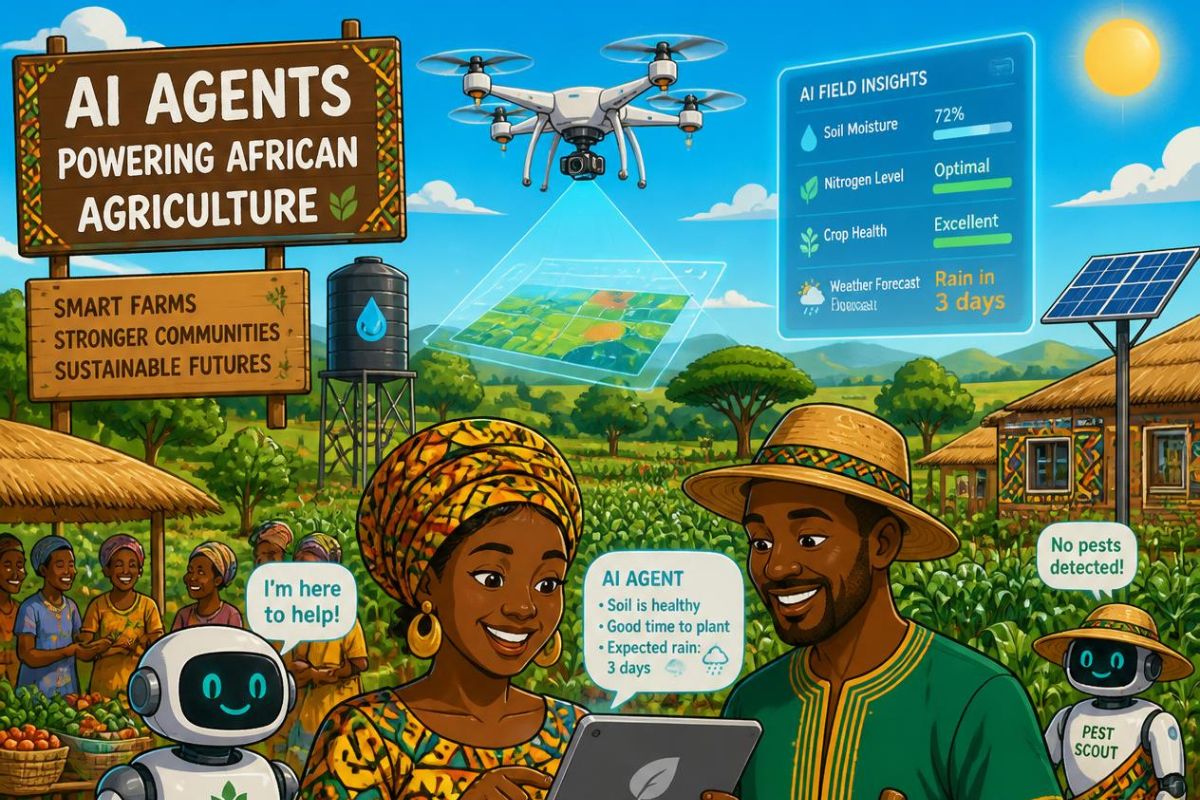
CropSense Advisory was built so that a farmer's language or digital skills don't decide whether they get good advice. It works on WhatsApp, with no app to download, and farmers can ask the way they talk.
For example: a maize farmer in Kano records a 20-second voice note in Hausa: the leaves in one corner of the field are curling and turning pale. CropSense transcribes it, checks the farm's planting date and the last two weeks of rainfall, and sees the same corner showing water stress on satellite. Within a minute, the farmer gets a short reply in Hausa: the crop is short of water, irrigate that corner within two days, and check again after.
- Seven languages, by text or voice: English, Nigerian Pidgin, Yoruba, Hausa, Igbo, Swahili and French. Farmers can type or send a voice note in any of them and get a written reply in the language they asked in, in short, plain words.
- Photos: farmers can share a photo of a leaf, a pest or a patch of the field for an AI-assisted assessment, read alongside the crop stage and field conditions.
- Advice that knows the farm: every registered farm builds a record of its crop, planting date, soil, weather and satellite crop monitoring, so answers fit that field this week rather than farming in general.
- Alerts before problems become losses: CropSense keeps watching between conversations and sends weather, pest, crop-stress and fertilizer-timing alerts when conditions change.
Accessibility takes more than translation, and it takes more than software. Through the CropSense Agricultural Intelligence Network, trained field agents work alongside the digital service, visiting farms to confirm what the data shows and helping farmers who need someone on the ground.
For cooperatives and aggregators, that makes CropSense Advisory a digital extension service: one AI agronomist that can reach every member in their own language, without adding field staff for every village.
Final Thoughts
The next big gains in African agricultural AI won't come from slightly smarter English models. They will come from services that understand a Hausa voice note, answer a Yoruba question in Yoruba, follow a farmer switching between Pidgin and English, and ground every answer in the farmer's own field. For African farmers, accessibility isn't a feature to add after launch. It is what decides whether digital advisory reaches them at all.
Prefer to ask in your own language? Chat with CropSense Advisory on WhatsApp in English, Pidgin, Yoruba, Hausa, Igbo, Swahili or French, by text or voice note.