Carbon Credits for African Farmers: What It Takes to Turn Sustainable Practices into Income
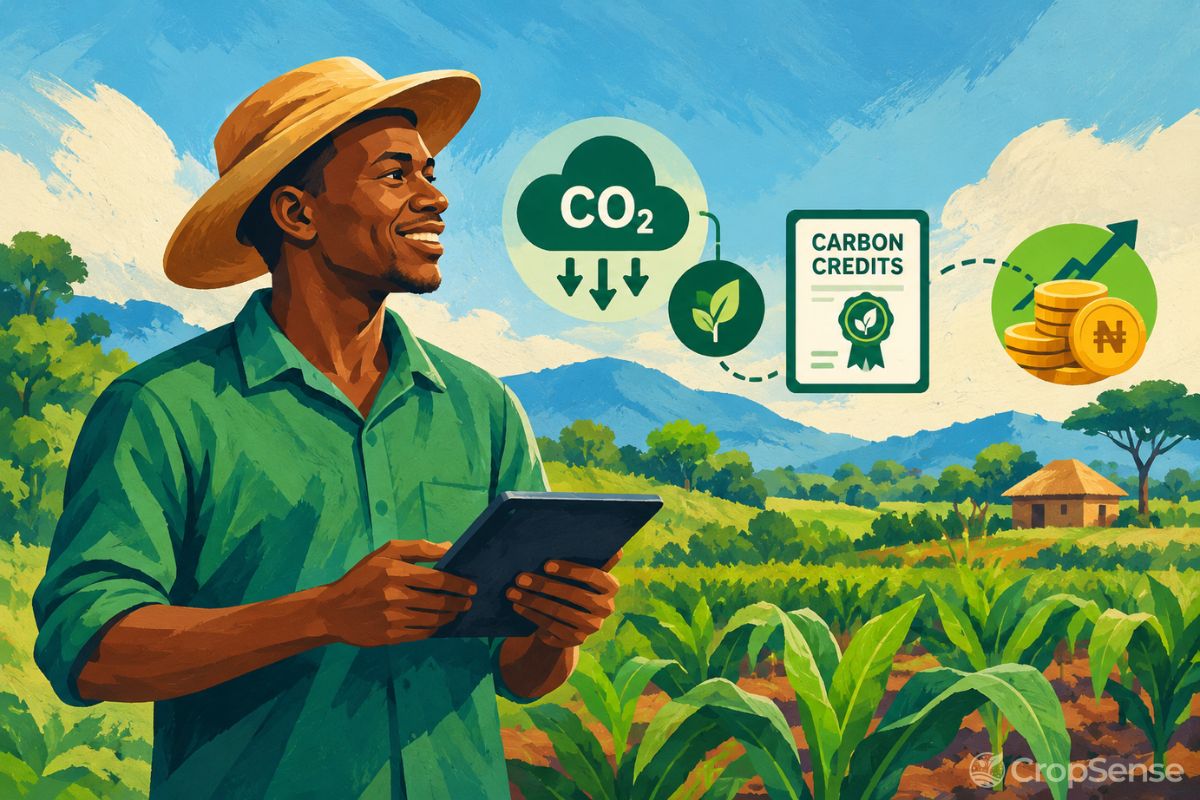
Carbon credits are being pitched to African farmers as a new source of income: plant trees, change how you manage your soil, and companies on the other side of the world will pay you for the carbon you store. For some farmers and cooperatives, carbon finance has brought real payments and useful support. For others, it has meant long contracts, delayed or tiny payments and promises that never arrived.
The difference usually comes down to the quality of the project, not the practice on the farm. This guide explains how agricultural carbon projects work, what generates a credit, what it takes for smallholders to take part and, most importantly, how to tell a credible carbon project from an attractive income promise.
How Agricultural Carbon Projects Work
A carbon credit represents one tonne of carbon dioxide (or an equivalent amount of another greenhouse gas) that has been removed from the atmosphere or kept out of it. Companies and governments buy credits to offset or report on their emissions. Before a credit can be sold, it goes through a long chain of steps:
- Project design. A project developer defines the area, the farmers involved and the practices they will adopt, using an approved methodology from a carbon standard such as Verra or Gold Standard.
- Validation. An independent auditor checks that the project design meets the standard's rules.
- Practice change and monitoring. Farmers adopt and keep up the agreed practices, while the project collects data on what changes on the land.
- Verification. An independent auditor checks how much carbon was actually stored or avoided over a monitoring period.
- Issuance. The standard issues credits into a public registry, each with a unique serial number.
- Sale and benefit sharing. The developer sells the credits and shares revenue with farmers under the terms of their contract.
Every step takes time and money. It is common for the first verification, and so the first credit revenue, to come years after farmers start changing their practices.
What Generates a Credit? Removals vs Reductions
Agricultural carbon credits come from two very different kinds of activity:
| Carbon removals | Emission reductions | |
|---|---|---|
| How it works | Pulling carbon out of the air and storing it in soils, trees and roots | Releasing fewer greenhouse gases than the farm otherwise would |
| Examples | Agroforestry, tree planting, practices that build soil organic carbon | Better fertilizer management (less nitrous oxide), rice water management (less methane), stopping crop residue burning |
| Main risk | Stored carbon can be released again if trees are cut, burned or die, or the soil is ploughed up | Proving how much would have been emitted without the project |
The distinction matters for farmers. Removal projects carry a long-term obligation: the carbon has to stay stored, sometimes for decades, and if it is lost, the project must replace those credits, a cost that can fall partly on farmers. Reduction projects don't carry the same storage risk, but they depend on accurate records of what the farm was emitting before.
Which Practices Could Qualify?
Many practices that are good for farms can also store carbon or cut emissions:
- Agroforestry and tree planting: trees on farm boundaries, in rows between crops or in woodlots store carbon in wood and roots, while providing shade, fruit, fodder and fuel.
- Soil management: reduced or no tillage, keeping crop residues on the field, cover crops, compost and manure can raise soil organic carbon over time.
- Grazing management: planned grazing that lets pastures recover can build carbon in rangeland soils.
- Nutrient management: applying the right amount of fertilizer at the right time cuts nitrous oxide emissions.
- Rice water management: alternate wetting and drying of paddies reduces methane.
Most of these practices also improve soil health, water retention and resilience, which is often their biggest benefit for the farm. See our guide to building climate resilience for more.
Important: adopting a practice does not, on its own, generate carbon credits. Credits only come from practices that are enrolled in a registered project under an approved methodology, measured against a baseline, independently verified and maintained for the length of the contract. A farmer who starts agroforestry or zero tillage independently has not created anything that can be sold.
How Is the Carbon Measured?
Measurement is where carbon projects succeed or fail. A credible project has to answer four questions:
- Baseline: what would have happened without the project? Credits are only issued for the difference between the baseline and what actually happened. A project that sets an inflated baseline issues credits for carbon that was never really stored or avoided.
- Additionality: would this have happened anyway? The Core Carbon Principles set by the Integrity Council for the Voluntary Carbon Market require that reductions or removals would not have occurred without the incentive created by carbon credit revenue. Paying farmers for practices they were already using for years doesn't count.
- Quantification and verification: how much changed, and who checked? Projects estimate carbon through a mix of direct measurement, such as soil sampling and laboratory analysis, models and default values. Independent auditors then verify the results before any credits are issued.
- Permanence and long-term monitoring: will it last? For removals, the carbon has to stay stored. Standards require projects to monitor for reversals and to manage the risk, often by holding back a share of credits in a buffer pool that covers losses.
Soil carbon is especially hard to measure. It changes slowly, varies from one corner of a field to the next and can only be measured precisely by taking soil samples to a laboratory. A 2024 study of soil carbon accounting approaches for smallholder projects, using the Western Kenya Soil Carbon Project as a case study, compared nine methods on accuracy, cost, standardisation and benefits to communities.
What credible measurement looks like on the farm
For farmers, measurement mostly comes down to two things: physical soil samples and good records of what happens on the farm.
- Soil sampling: samples taken from marked points at set depths, before practices change and again at intervals over the project, then analysed in a laboratory. Measuring the same points each time is what shows whether soil carbon has really increased. Our soil testing guide explains how sampling works.
- Farm activity records: what was planted and when, fertilizer and manure applied, tillage, how crop residues were handled, trees planted and how many survived, backed by dated photos where possible. These records show that agreed practices were actually kept up, and auditors check them during verification.
Satellite imagery plays a supporting role, such as confirming field boundaries and how land was used before the project, but it does not replace soil sampling or farm records.
Can Smallholder Farmers Participate?
Yes, but rarely on their own. A single smallholder farm stores too little carbon to cover the cost of design, measurement and verification. Smallholders take part through aggregation: a cooperative, NGO or project developer groups thousands of farms into one project and spreads the costs across them.
There are working examples. The Kenya Agricultural Carbon Project, run by Vi Agroforestry with around 60,000 smallholders on 45,000 hectares, became in 2014 the first project to earn Verified Carbon Standard credits for storing carbon in soil, with 24,788 tonnes of CO₂ credited. In the TIST programme, farmers in small groups plant and look after trees and, according to Verra, receive yearly advance payments for each tree and 70% of the profits from carbon credit sales.
Before joining any project, smallholders and cooperatives should understand four things:
- Participation costs. Project design, audits, monitoring and registry fees are significant. Most are paid by the developer, then recovered from carbon revenue before profits are shared. Ask what is deducted, and how much.
- Land rights. You can only commit carbon on land you have clear rights to use for the length of the contract. Where land is held communally, the whole community must give informed consent. In January 2025, a Kenyan court ruled that two conservancies in the Northern Kenya Rangelands Carbon Project had been set up without adequate public participation, and the carbon standard Verra placed the project on hold.
- Contractual obligations. Carbon contracts can require you to maintain practices, keep trees standing and allow monitoring for many years. Breaking those commitments can mean losing payments or even repaying them.
- National rules. Governments are starting to regulate carbon projects. Kenya's 2023 climate change law, for example, requires an annual social contribution of 40% to the community for land-based projects, with later regulations setting out how it applies. Check what applies in your country.
For cooperatives already managing many farms, the same records that support carbon projects also support buyers and lenders. See our guide to digitizing outgrower schemes.
What to Check Before You Sign
A carbon contract can bind your land for many years, so read it as carefully as you would a land lease or loan. Ask for it in a language you understand, and get advice from your cooperative, a lawyer or a trusted extension officer before you sign. Key questions:
- Who is the developer, and which standard is the project registered under? Ask for the project name and registry ID, and check that it appears on the standard's public registry.
- How is revenue shared? What percentage goes to farmers, and is it a share of gross revenue or of profit after costs? Which costs are deducted before your share is calculated?
- When will you be paid? Is there any advance payment? When is the first verification expected, and how often will payments come after that?
- Who is responsible for losses or reversals? What happens if trees die, a fire burns the field, drought hits or you sell the land? Will you have to repay anything, or does a buffer pool cover it?
- Who owns your data? Farm boundaries, GPS points, photos and yield records are valuable. Can the developer share or sell them, and can you get a copy?
- How can you complain? Is there a clear grievance mechanism, with a named contact and a process that is independent of the people you are complaining about?
- Can you leave? What are the exit terms, and what do you owe if you withdraw early?
Credible Project or Attractive Promise?
The strongest protection is knowing the warning signs. Be wary of any carbon offer that promises a specific income before your land has been measured.
| Warning signs | Signs of a credible project |
|---|---|
| Guaranteed earnings per acre or hectare, before any measurement | Payments linked to verified credits, with a realistic timeline |
| Asks farmers to pay a fee to join | Costs explained in writing and recovered transparently from carbon revenue |
| Can't name the standard, methodology or registry | Registered with a recognised standard and listed on a public registry |
| Pressure to sign quickly, or no written contract | Time to review, a contract in your language and community consultation |
| Pays for practices you already used for years | Clear baseline and a credible case for additionality |
| Vague about who carries the risk of reversals | Buffer pool and reversal rules explained up front |
| No way to raise complaints | Accessible grievance mechanism with a named contact |
Be realistic about the money, too. Carbon revenue per farm depends on the project's verified results, the price its credits sell for and the costs deducted before payment, and for smallholders it is usually modest. The practices themselves, through healthier soils, more resilient yields and products from trees, often deliver more value to the farm than the carbon payments.
Final Thoughts
Carbon finance can reward African farmers for practices that store carbon and cut emissions, but only through projects that measure honestly, share revenue fairly and respect farmers' land and data rights. Before signing, ask who is behind the project, how it is measured and verified, how and when you will be paid, and what happens if things go wrong. A credible project will welcome those questions. An attractive income promise usually won't.
Assessing or developing an agricultural carbon project? Book a meeting with our team to see how CropSense farm mapping, baseline records and farm activity records can support your project.