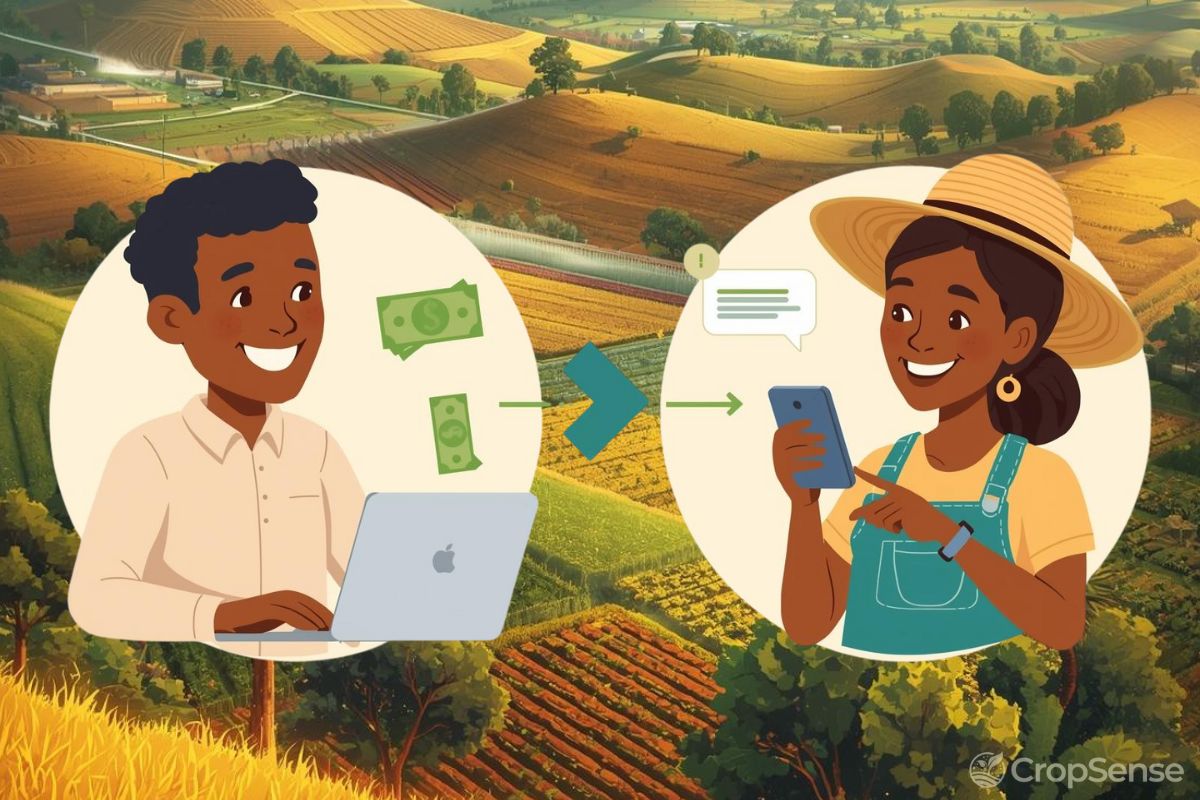
Agri-Fintech in Africa: 5 Real-World Applications Transforming Farm Finance

Across Africa, smallholder farmers generate over 70% of the continent's food supply, yet agriculture receives under 5% of commercial bank lending. Traditional financial institutions have historically labeled smallholders "unbankable" due to informal record-keeping, remote locations, and vulnerability to unpredictable climate events.
This structural mismatch has created an estimated $65 billion annual smallholder financing gap. However, a wave of agri-fintech platforms is fundamentally changing this dynamic. By replacing manual site visits and collateral demands with satellite intelligence, mobile infrastructure, and machine learning, agri-fintech is building the financial rails for African agriculture.
1. Alternative Credit Scoring: Turning Data into Collateral
Featured Innovator: CropSense AI
The primary barrier to agricultural lending is visibility: commercial banks cannot cost-effectively assess loan risk for a half-hectare maize farmer living hundreds of kilometers from the nearest branch. Agri-fintech eliminates this blind spot through alternative credit scoring engines.
Instead of demanding bank statements or land titles, platforms build dynamic credit profiles using non-traditional data sources:
- Geospatial & Remote Sensing: Satellite imagery (e.g., Sentinel, Landsat) tracks historical Normalized Difference Vegetation Index (NDVI) levels to verify past crop performance, field boundaries, and soil moisture levels.
- Agronomic Inputs: Data on seed choices, fertilizer purchases, and planting timelines feed predictive AI yield models that calculate expected post-harvest income.
- Mobile Money Records: Transaction histories from platforms like M-Pesa or MTN Mobile Money establish cash flow patterns and baseline financial discipline.
How CropSense AI solves this: CropSense AI utilizes its proprietary YieldRank Engine to translate satellite telemetry, satellite-derived historical yield data, and regional climate risks into standardized credit risk scores. This allows commercial banks, microfinance institutions (MFIs), and input providers to underwrite smallholder loans automatically without performing costly field audits.
2. Index-Based & Parametric Crop Insurance: Climate Mitigation at Scale
Featured Innovator: OKO Finance · Intelligence Layer: CropSense AI (YieldSecure)
Traditional indemnity insurance fails in rural African agriculture because sending physical claims adjusters to evaluate minor crop damage on millions of isolated farms incurs higher operational costs than the policies themselves.
Index-based parametric insurance solves this operational bottleneck by automating payouts based on verified environmental triggers rather than physical damage assessments:
| Feature | Traditional Crop Insurance | Index-Based Parametric Insurance |
|---|---|---|
| Verification Method | Manual on-farm physical inspections | Automated satellite & weather station data |
| Payout Trigger | Proven percentage of physical yield loss | Exceeding predefined weather indices (e.g., days of drought) |
| Processing Time | Months (pending claims adjustments) | Days (automated via mobile money) |
| Operational Cost | High (expensive field agents) | Low (scalable satellite API feeds) |
How OKO Finance solves this: Operating across markets like Mali, Uganda, and Côte d'Ivoire, OKO Finance uses satellite imagery and local weather data to create affordable, crop-specific parametric policies. When satellite sensors register severe drought or excess rainfall during critical crop cycles, OKO automates instant compensation payouts directly to farmers' mobile wallets via USSD without requiring paper claims or physical inspections.
How CropSense AI fits in: Parametric products live or die on the quality of the trigger design and monitoring behind them. YieldSecure, CropSense AI's parametric insurance engine, is built to be that intelligence layer: it defines peril-specific triggers for drought, flood and rainfall deficit, continuously monitors every insured farm against them through the season, and calculates the resulting payout the moment a threshold is breached. As with YieldRank, CropSense AI is not the insurer — insurers and reinsurers plug YieldSecure into a parametric product to get the data and trigger infrastructure without building satellite monitoring in-house.
3. Asset Financing & PAYG (Pay-As-You-Grow) Equipment
Featured Innovator: SunCulture
High upfront capital costs prevent smallholders from adopting productivity-enhancing hardware like solar irrigation pumps, cold storage units, and processing equipment.
To bridge this gap, companies utilize Asset Financing backed by Pay-As-You-Grow (PAYG) fintech models:
- IoT Remote Lockout: Equipment is fitted with smart Internet-of-Things (IoT) sensors. Farmers make micro-payments via mobile money (daily, weekly, or monthly) tied directly to their harvest revenue cycles. If payments stall, the IoT controller remotely pauses the device until payment resumes.
- Climate & Carbon Credit Subsidies: Providers integrate carbon offset monetization into their financing engines to subsidize the upfront purchase price for farmers, drastically lowering loan entry barriers.
How SunCulture solves this: Based in Kenya, SunCulture pairs high-efficiency solar water pumps with a micro-leasing PAYG model. By allowing farmers to pay off their solar irrigation systems in small installments through mobile money while using carbon credits to lower prices, SunCulture helps smallholders transition from rain-fed farming to high-yield, year-round commercial production.
4. Digital Payment Networks & Closed-Loop Cashflow
Featured Innovator: Crop2Cash
Cash-based rural supply chains are vulnerable to theft, high settlement delays, and severe record opacity. Agri-fintech platforms are replacing cash with mobile-first, closed-loop payment systems designed specifically for agricultural supply chains:
- Direct Produce Pay-outs: Off-takers and food aggregators disburse payment directly to smallholders upon crop delivery via mobile money, building a verifiable financial history for the farmer.
- E-Vouchers & Smart Input Credit: Rather than disbursing cash loans — which carry the risk of side-spending — fintech lenders issue digital e-vouchers redeemable exclusively at certified local agro-dealers for approved seeds, fertilizers, and crop protection products.
- Warehouse Receipt Financing (WRF): When farmers store harvested crops in licensed, accredited warehouses, digital platforms issue asset-backed electronic receipts. Farmers can use these digital receipts as collateral to obtain immediate short-term liquidity while waiting for post-harvest market prices to rise.
How Crop2Cash solves this: Nigerian startup Crop2Cash digitized the agricultural supply chain by offering USSD-based digital payment networks and input marketplaces. Through their platform, agro-processors disburse payments digitally to smallholder farmers upon crop delivery. This closed-loop transaction history gives banks the verified cash flow records needed to safely extend input credit back to those same farmers, a model that also strengthens digitized outgrower schemes run by large aggregators.
5. Bundled Agritech Ecosystems: End-to-End Value Chain Finance
Featured Innovator: Apollo Agriculture
Standalone financial products often struggle in rural markets because offering credit without high-quality inputs leads to crop failure, while offering inputs without agronomic guidance leads to misuse.
To solve this, leading agritech platforms have shifted toward bundled service ecosystems:
- Full-Stack Value Chain Integration: Platforms bundle high-yield seeds, fertilizer, climate insurance, agronomic advice, and guaranteed market off-take into a single credit package.
- Risk Reduction for Lenders: By controlling the input supply, monitoring crop health via satellite mid-season, and managing post-harvest sales directly to corporate off-takers, bundled platforms eliminate side-selling and dramatically reduce default rates.
- Scalable Farmer Onboarding: Farmers interact with one unified digital platform for all their operational and financial needs, turning a fragmented rural ecosystem into a structured, bankable pipeline.
How Apollo Agriculture solves this: Apollo Agriculture leverages a machine-learning platform that bundles hybrid seeds and fertilizers, micro-insurance, agronomic advice, and input credit. By using satellite telemetry to monitor crop health mid-season and managing the end-to-end relationship from input delivery to harvest sale, Apollo optimizes farm yields while maintaining lower credit default rates.
Conclusion: Bridging the Gap in African Agriculture
The convergence of satellite Earth observation, mobile money infrastructure, and machine learning is fundamentally shifting African agriculture from a high-risk gamble into a predictable, data-backed asset class. By eliminating information asymmetry and operational friction, agri-fintech platforms are proving that smallholder farmers are not unbankable — they were simply unmeasured.
As these technologies continue to mature, financial institutions that embrace data-driven risk management will unlock unprecedented commercial opportunities across the continent's agricultural value chains.
De-risk your agricultural portfolio with CropSense AI. Discover how our YieldRank Engine leverages real-time satellite telemetry and predictive crop analytics to deliver automated credit scoring and portfolio monitoring for banks, microfinance institutions, and agritech platforms.